

Entry Guidelines
Entry Guidelines
I. Eligibility & Divisions
All submissions must be uniformly registered and submitted by their affiliated schools or institutions. CIDCE will manage submission records, program communications, and the delivery of professional adjudication results exclusively through these representing institutions.
1|Individual Division
The Individual Division includes:
Solo
Duet
Trio
All performers in a Duet or Trio must belong to the same age group.
Age Groups
Age 6 & Under
Ages 7–10
Ages 11–15
Ages 16–18
Ages 19–29
Age 30-49(average age)
Age 50 and up(average age)
Age groups for this program are determined by each participant’s actual age as of December 31, 2026.
The age group established on that date applies throughout the full program cycle and does not change when the calendar year moves into 2027.
2|Group Division
Works with 4 or more performers enter the Group Division.
Group works are divided according to the ages of all participating performers:
Children
Performers must be age 10 or under.
Youth
All performers must be between the ages of 11–18.
Adult
The average age of all performers must be between 19-49.
Evergreen
The average age of all performers must be age 50 or up.
Group Division age eligibility is also determined by each performer’s actual age as of December 31, 2026. All performers in a group work must meet the requirements of the applicable age category.
II. Repertoire Categories
Both the Individual and Group Divisions include two repertoire categories.
Repertoire Work
A Repertoire Work is an existing, established dance work that participants study and perform.
The work must not have been originally created or newly choreographed by the current participant, teacher, or participating school specifically for this submission entry.
Original Work
An Original Work is a dance work originally or newly created for the participating performers by the participating school, teacher, or choreographer.
Dance Categories
Both Repertoire Works and Original Works are registered under the following professional categories:
Chinese Classical Dance
Shenyun
Han–Tang
Dunhuang
Chinese Ethnic & Folk Dance
Ethnic Minority Dance
Han Folk Dance
Work Duration
All Individual and Group Division entries must have a complete performance duration of:
3–7 minutes
Both 3mins and 7mins are included within the permitted duration.
III. Video Submission
The submission video is an important professional adjudication material and must present the work clearly, completely, and authentically.
To allow works to be viewed under reasonably consistent conditions, all submitted videos must follow the recording and submission standards below.
Recording Date
The submission video must be a complete recording of the work made within the six months preceding the submission date.
Continuity & Authenticity
The submission video must be recorded as one complete, continuous take, preserving the uninterrupted performance from beginning to end.
The video must remain a single continuous recording and may not include:
editing or splicing of footage;
multiple-camera recording or camera cuts;
separately re-recorded sections inserted into the performance;
any other treatment that alters the original continuity of the performance.
The video must retain the original synchronized audio from that recording, allowing adjudicators to assess the relationship between the dancers’ actual performance and the music heard at the time of recording.
To preserve the authenticity of the recording, the following are not permitted:
replacing the original synchronized audio in post-production;
substituting or re-scoring the music;
re-recording and overlaying the original sound;
post-production noise reduction;
other audio processing that alters the original synchronized sound.
Camera Position
Submission video must use:
landscape orientation;
a fixed, front-facing camera position;
a centered and reasonably level frame;
framing that fully covers the primary performance area;
continuous, clear visibility of the performers’ full bodies throughout the work.
The camera must remain fixed throughout the recording. The following are not permitted:
zooming in or out;
panning or other camera movement;
pronounced side-angle recording;
overhead or low-angle recording;
fisheye effects;
wide-angle effects that noticeably distort body proportions, perspective, or spatial relationships;
other visual effects that may interfere with professional adjudication.
A video resolution of 1080p or higher is recommended.
Recording Space
Submission video must be recorded in an appropriate indoor environment that allows the dance work, body lines, and spatial relationships to be presented clearly and consistently, such as:
a dance studio;
rehearsal studio;
stage;
another indoor performance space offering comparable conditions.
Videos recorded in homes, outdoors, or in other environments that clearly do not allow the work, body lines, and spatial relationships to be presented adequately do not meet the video submission requirements for this program.
Costumes, Makeup & Props
Participants may use the following as appropriate to the artistic needs of the work:
performance costumes;
makeup and styling;
stage props directly related to the work.
The video image must preserve participant anonymity. It therefore may not display information that directly identifies the participant’s school, institution, teacher, or other affiliation, including:
names;
logos;
text;
other clearly identifying marks.
Identifying Information in the Video
The submission video itself must remain anonymous and uncluttered. It may not include:
opening or closing title cards;
subtitles;
watermarks;
school or institution names;
teacher or choreographer names;
participant names;
other identifying information.
The work title, participant name, school name, or institution name may not be spoken within the recording.
The work title may be submitted as part of the entry and will be displayed to adjudicators as part of the official adjudication information.
Video Link Submission
To ensure the professionalism of the adjudication process and the absolute fairness of the blind review, all participating institutions and lead teachers must strictly adhere to the following video submission specifications:
Exclusively Designated Video Platform Each participating piece must be submitted via an independent YouTube video link. This online audition strictly permits only YouTube links (i.e., Google Drive, Vimeo, and Dropbox links are not accepted, nor are any directly uploaded MP4/MP3 attachments).
Playback Permissions and Privacy Settings Videos uploaded to YouTube must have the "YouTube Kids" setting turned off. Lead teachers may set the video's visibility to "Unlisted," but it must absolutely not be set to "Private". Furthermore, please ensure that the "Allow embedding" option is enabled in the advanced settings so the adjudication system can properly access and play the video. The link should remain active from the date of submission through the conclusion of the Gathering in Motion Gala.
Recording and Dress Code Specifications Regarding camera placement (which must clearly show the complete body using a stationary camera position), audio authenticity (post-production sound mixing or audio dubbing is strictly prohibited), dress code for participating dancers, blind adjudication principles, and account upload declarations, please strictly comply with the relevant regulations detailed in Entry Guidelines: Section III, Video Submission.
Materials After the Registration Deadline
Once registration closes, adjudication is based on the work and video content formally submitted by the deadline.
To maintain consistency of submitted materials, entries may not replace, re-record or substitute different video content after the deadline.
If CIDCE is unable to access the original video because of:
a broken or inactive link;
incorrect access permissions;
another purely technical issue;
the school or institution may, following CIDCE confirmation and within the designated period, restore the original link, correct the access permissions, or resubmit the same original video.
Technical correction is limited to restoring access to the original submitted material and may not alter the work or the video content formally submitted for adjudication.
IV. Adjudication Process
Anonymous Adjudication
Following the registration deadline, CIDCE assigns submission numbers and prepares anonymized adjudication materials for all entries meeting the program requirements.
The administrative registration record submitted by the school or institution is kept separate from the professional adjudication materials used by the jury, allowing adjudicators to focus on the work itself.
CIDCE separates administrative registration records from adjudication materials and masks names, school affiliations, and other identifying information not needed for assessment. This reduces the influence of identifying information but does not guarantee that an adjudicator cannot recognize a participant or work. Conflict-of-interest disclosure and recusal procedures continue to apply.
Adjudicators Can See
submission entry number;
work title;
Individual Division / Group Division;
Solo / Duet / Trio / Group;
age group;
Repertoire Work / Original Work;
dance category;
work duration;
anonymized submission.
Adjudicators Do Not See
participant names;
school or institution names;
teacher names;
choreographer names;
other identifying information not directly relevant to professional adjudication.
Anonymous adjudication is intended to reduce the influence of participant background, school relationships, and other factors external to the work, allowing each entry to be viewed and assessed on the basis of its own artistic and professional qualities.
Adjudicators
Each work meeting the submission requirements and entering formal adjudication is independently assessed online by 2–3 professional dance adjudicators.
As a general principle, adjudicators should not have teaching, coaching, advisory, or other interests involving the relevant participant, school, or institution that could directly compromise independent professional judgment.
Each adjudicator assigned to a work independently completes the professional assessment, scoring, and corresponding Recorded Jury Feedback according to the published program standards.
Where recusal or another reasonable circumstance requires a change in panel configuration, CIDCE will assign an appropriate qualified adjudicator in accordance with the program’s adjudication principles, supporting both professional independence and integrity of the process.
V. Judging Criteria
Gathering in Motion adjudication begins by understanding and respecting the artistic language of Chinese dance through which each work establishes itself.
Core Adjudication Principle
Adjudicators first understand the artistic language through which a work establishes itself, and then assess whether the work fully realizes its own expression.
Technique is an essential foundation of professional dance practice and an important means through which style, physical quality, and artistic expression are realized.
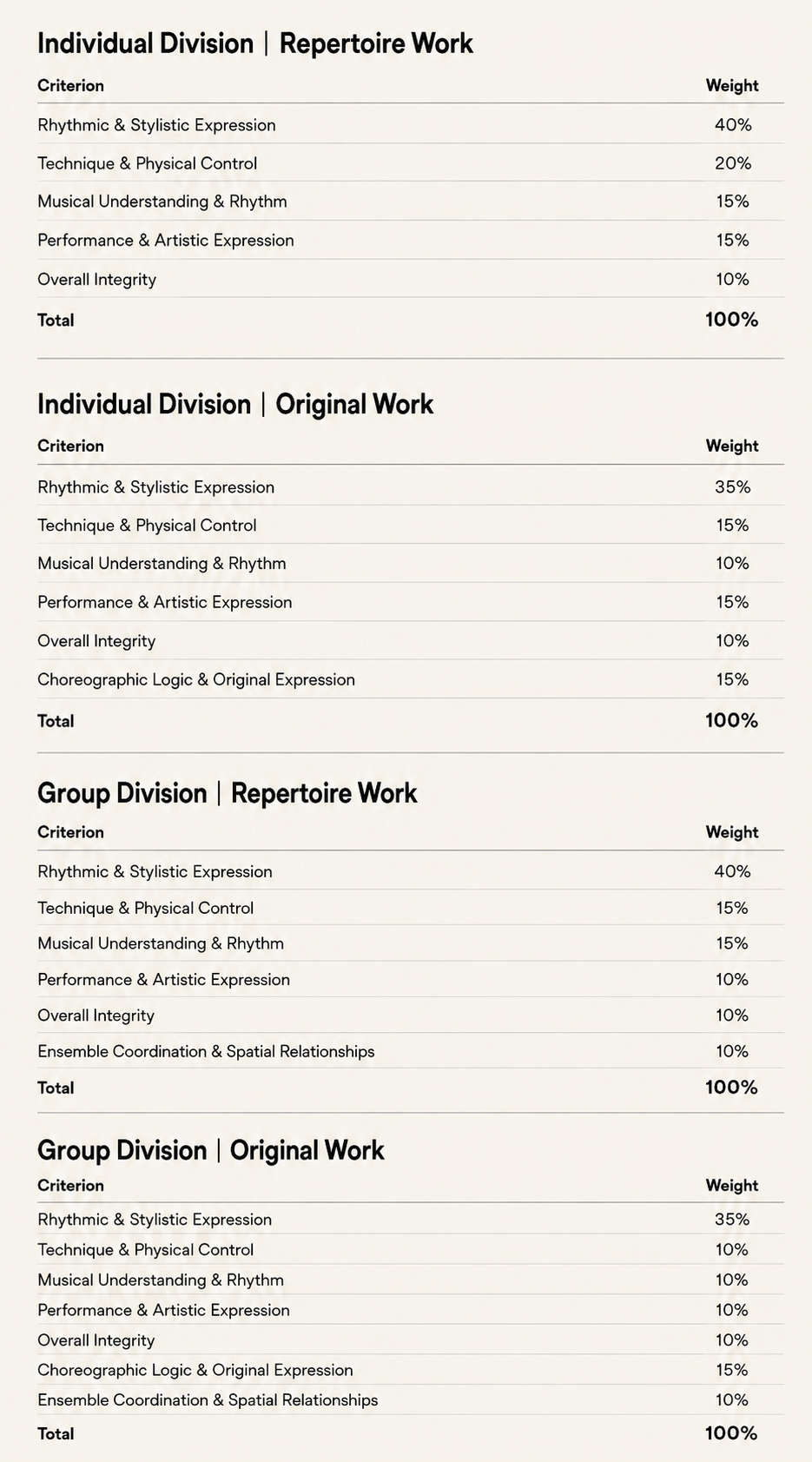
Adjudication therefore considers the work across the following dimensions:
rhythmic and stylistic expression;
technique and physical control;
musical understanding;
performance and artistic expression;
overall integrity of the work;
choreographic logic in Original Works;
ensemble and spatial relationships in Group Works.
Among these:
Rhythmic & Stylistic Expression
is a core criterion in the adjudication of Chinese dance.
This criterion considers whether performers genuinely understand and embody the artistic language of the relevant dance form, including bodily rhythm, movement dynamics, breath, movement quality, and characteristic stylistic features, and how these qualities come together to form a convincing embodied expression.
Ensemble Coordination & Spatial Relationships
This criterion considers how group works create coherent stage expression through ensemble relationships and spatial organization, including:
coordination and relationships among performers;
spatial organization and formation structure;
stage pathways and transitions;
collective flow and shared rhythm;
relationships between individual performers and the ensemble as a whole.
Adjudicators consider whether these elements are clear, effective, and meaningfully support the artistic expression and overall structure of the work.
Synchronization and precision are part of ensemble performance; relationships among performers, spatial organization, and the overall stage structure together form the broader professional judgment represented by this criterion.
VI. Scoring & Results
Scoring Method
Each eligible work that advances to the formal adjudication process will be independently evaluated by 2 to 3 professional adjudicators.
Adjudicators will conduct their professional assessments and assign scores based on the adjudication criteria and corresponding weights outlined in Section V. Each adjudicator’s evaluation is conducted independently; final results are not subject to collective negotiation or panel consensus.
The final score for each work is calculated as the arithmetic mean of the total scores awarded by all eligible adjudicators who officially reviewed the piece.
This final result is derived directly from the actual evaluations without dropping the highest or lowest scores, ensuring that every participating adjudicator's professional assessment fully contributes to the work's final standing.
In operational practice, CIDCE will make every effort to maintain consistency in panel configuration and adjudication conditions within the same evaluation category.
Where recusal for conflicts of interest, unforeseen emergencies, or other reasonable circumstances requires a change in panel configuration, the final result will still be calculated as the average of the scores provided by the eligible adjudicators who actually completed the formal review of that specific work.
Tied Results
CIDCE permits the professional adjudication results to authentically reflect tied scores between works.
If two or more participating works achieve the same final score, they will jointly retain that score. There is no need to artificially alter the original scores simply to force a ranking order.
Should a specific artistic recognition require further professional assessment, it will be determined according to the unique granting criteria of that recognition. This ensures that the specialized artistic recognition and the work’s original adjudication score remain distinct, transparent, and intact.
Adjudication Results & Professional Feedback
Official adjudication results will be confirmed upon the completion of the relevant adjudication procedures and necessary administrative verification by CIDCE.
Participating schools or institutions will receive professional result packages for their submitted works, which include:
each adjudicator’s criterion scores and total score;
the work’s final score;
Recorded Jury Feedback from every adjudicator who formally assessed the work.
All officially participating works will receive a digital certificate of participation. Works that achieve artistic recognition will concurrently receive a corresponding official digital certificate of recognition.
For specific categories of artistic recognition and their granting principles, please refer to the "Artistic Recognition" section.
Detailed scores and adjudicator feedback are delivered privately as professional resources for the schools, the works, and the involved participants, providing specific references for future review, teaching, and artistic development.
The adjudication results publicly released by CIDCE will primarily feature formally granted artistic recognitions and authorized professional credits, ensuring that public records remain focused on the professional recognition achieved by the works.
Verification and Correction of Results
The artistic and professional assessments made by the adjudicators, based on the established adjudication standards, constitute the official adjudication results.
Different professionals may form varying interpretations regarding artistic perspectives, aesthetic assessments, or the artistic treatment of a work. Disagreements concerning the professional assessments themselves do not constitute grounds for rescoring or altering the adjudication results.
CIDCE will accept and investigate objective administrative or technical issues, including:
score-entry errors;
calculation errors;
incorrect matching of work and result information;
technical errors arising during the compilation or archival processing of adjudication results.
Should CIDCE confirm the existence of an objective administrative or technical error, necessary corrections will be made, and a clarification will be provided to the relevant school or institution.
Adjudication Results & Subsequent Opportunities
Professional adjudication, the granting of formal artistic recognition, live showcase invitations, and collaborative artistic development are interconnected components, yet each serves a distinct professional function.
Works that achieve artistic recognition will enter the curatorial selection pool for the live showcase. Based on the adjudication results, CIDCE will separately issue formal invitations for live presentation, taking into consideration the professional quality of the works, theater staging conditions, and actual production feasibility.
Among the works confirmed for the live showcase, CIDCE will conduct an independent artistic selection to invite specific pieces into the collaborative artistic development phase of Gathering in Motion.
This curatorial selection is guided by the project's artistic direction, the unique characteristics of the works, and practical production conditions, generating further opportunities for collaboration, rehearsal, and artistic evolution for the selected pieces.
Adjudication is not programming.
Professional adjudication and subsequent program curation assume distinct professional responsibilities.
Adjudicators are responsible for professional assessments during the adjudication process; CIDCE is responsible for subsequent live presentation planning, artistic selection, and production decisions.
Both operate in accordance with their clearly defined professional roles and corresponding standards, jointly constituting the comprehensive mechanism of the Gathering in Motion project—from professional adjudication to subsequent artistic practice.